
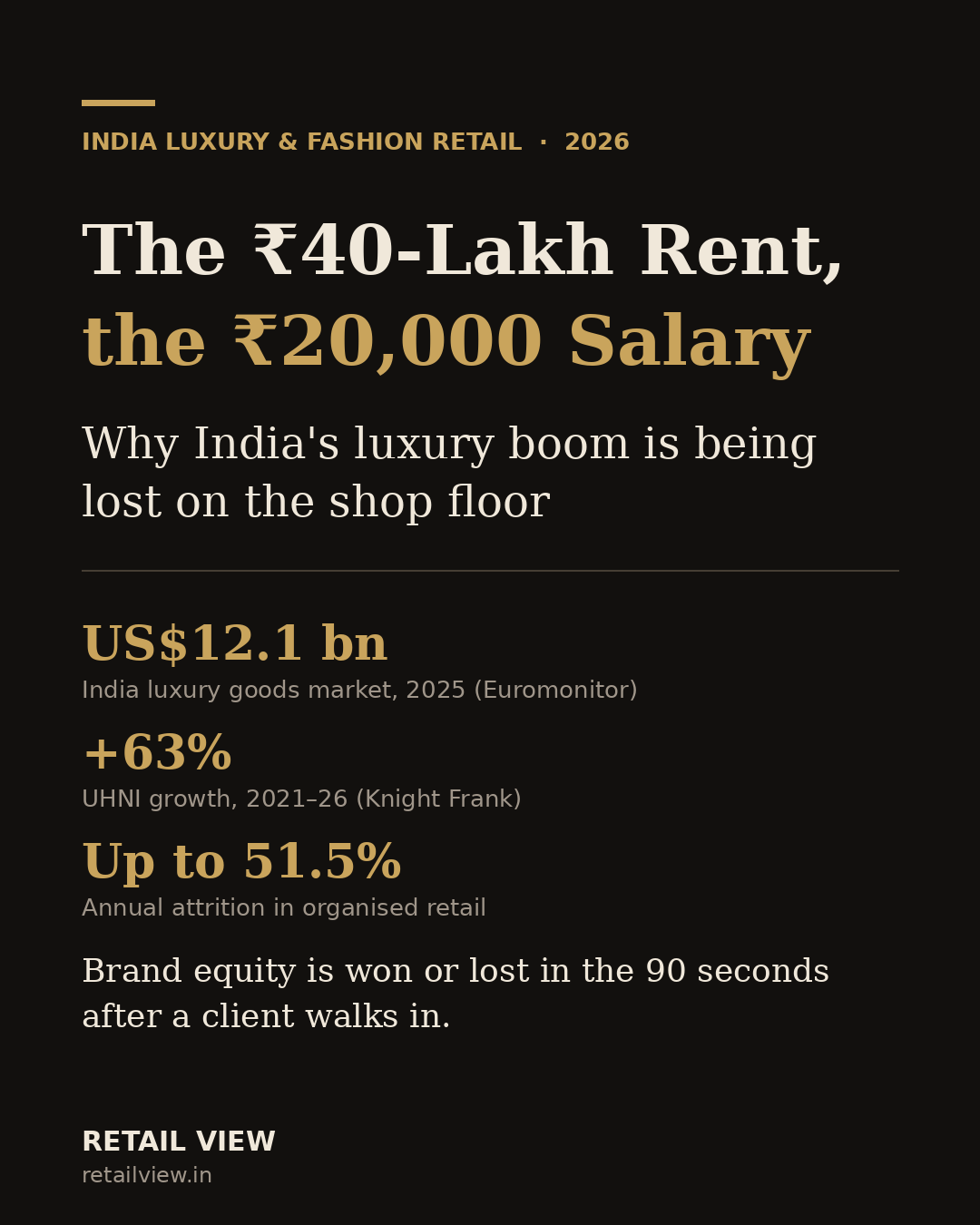
Malls are filling up and global labels are arriving. But in 2026, brand equity is won or lost in the 90 seconds after a client walks in, and most training programmes still aren’t built for that moment.
Bottom line: Indian luxury, premium apparel and footwear retail has a capability gap, not a footfall problem. Brands that keep training for product recall and greeting scripts, instead of fit diagnostics, cultural fluency and disciplined clienteling, will keep paying flagship rents for sales that end up in Dubai.
The Store-Floor Reality
It’s a Saturday afternoon at a premium footwear boutique in a South Delhi mall. A woman in her forties picks up a pair of Italian block heels priced at ₹68,000. She turns the shoe over and asks one question: “Will these hurt by the end of a sangeet?”
The associate is 24, from a Tier-2 town and four months into the job. He freezes. He doesn’t ask about her arch, her usual width or how long she’ll be standing. He doesn’t mention the padded footbed or the heel pitch. Instead he says what he has been trained to say: “Ma’am, there’s a 10% offer on the new collection.”
She smiles politely, puts the shoe down and leaves. She’ll buy a pair in Dubai next month.
This isn’t hypothetical. A 2026 Business Today profile of affluent Indian buyers describes a 41-year-old shopper who bought Valentino heels for about ₹1.3 lakh, chosen for comfort because she has flat feet. The customer is diagnosing her own fit. The question is whether the associate can.
The Core Tension: Global Standards, Local Talent, Legacy Inductions
The money is real. Euromonitor data reviewed by Reuters put India’s luxury goods market at US$12.1 billion in 2025. Knight Frank’s Wealth Report 2026 counts India’s ultra-high-net-worth individuals rising 63% between 2021 and 2026, from 12,161 to 19,877. The Mercedes-Benz Hurun India Wealth Report 2025 counts 8,71,700 millionaire households, up 90% since 2021.
Space is scarce, and the stakes per square foot are high. Reuters reported in March 2026 that India has only three true luxury malls: DLF Emporio and The Chanakya in Delhi, and Jio World Plaza in Mumbai. DLF’s head of luxury malls, Saurabh Bharara, told Reuters: “We have top 15 brands that are ready to enter India, if we give them space tomorrow.” At Jio World Plaza, Louis Vuitton agreed to pay ₹40.5 lakh a month for 7,365 sq ft, or a share of net revenue if that is higher, according to widely reported lease details.
Now set that against the person on the floor. Payscale puts the average entry-level retail sales associate in India at about ₹2.24 lakh a year, or roughly ₹18,700 a month. Indeed’s average for the role is about ₹22,400 a month. In plain terms, a flagship’s monthly rent can be around 200 times the monthly pay of the associate expected to convert its footfall.
New hubs are growing faster than talent pipelines. Phoenix Mall of Asia in Bengaluru opened in October 2023 with more than 160 international labels. On Phoenix Mills’ Q2 FY27 earnings call in October 2026, management said the mall’s trading density had crossed ₹3,300 per sq ft, with trading occupancy at 96%. Knight Frank’s 2026 International Brand Penetration Ranking puts Chandigarh at the top of India’s Tier-2 cities. Redseer’s 2025 luxury report finds that more than half of sales on marketplaces such as Tata CLiQ Luxury and Ajio Luxe now come from non-metro pin codes, including Ludhiana, Surat, Jaipur and Indore.
The customer has moved up; the associate often hasn’t. Kearney’s Neelesh Hundekari describes a key new buyer as the small-business owner “who may be worth Rs 100 crore.” An associate trained to read wealth from metro signals such as accent, logos and car keys will misjudge this client every time.
Attrition makes everything worse. Good Business Lab notes that organised retail attrition in India has historically run at 22–51.5% a year, against a cross-industry average of 17.1% in 2025. It cites TeamLease’s estimate that replacing a frontline employee costs about 40% of annual salary.
The induction model hasn’t changed. Most brand onboarding is still a multi-day classroom session built on slide decks: brand history, SOPs and a product dump. The national Retail Sales Associate curriculum approved by RASCI runs to 280 hours across 16 occupational standards. That builds a sound general base, but it wasn’t designed to teach the difference between Goodyear-welted and Blake-stitched soles, or how to open a conversation with an NRI bride’s mother. Meanwhile the collection changes every season, the capsule drops every month, and half of last year’s cohort has left.
Five Defining Shifts in Luxury, Apparel & Footwear Training Today
1. Technical Craft & Fit Diagnostics over Feature Lists
Product mastery is the alternative to discounting. Kearney senior partner Neelesh Hundekari told Business Today in November 2026 that a luxury product costs about 20% more in India than in Dubai, Singapore or London, while buyers will pay a premium of only 5–10% to buy at home. That leftover gap can’t be closed with an offer. It can only be closed with expertise the customer can’t get on a flight.
Good training now teaches associates to diagnose before they describe:
- Footwear: read arch type, forefoot width and instep height; explain how the last shapes fit; match heel pitch to the occasion; know the leather grade (full-grain vs. corrected) and explain why it breaks in differently.
- Apparel: compare drape in crepe and georgette; explain why a Super 120s wool suits Delhi winters; tell the story of a weave, whether Benarasi, Chanderi or Italian jacquard, in two sentences rather than reciting the hangtag.
2. Confidence Coaching & Luxury Etiquette (The “Attentive, Never Hovering” Balance)
The confidence gap is rarely a knowledge gap. It is an associate from a middle-class or Tier-2 background unsure whether they have the standing to advise a globally travelled client.
Leading programmes now treat poise as a trainable skill: voice modulation, pacing, knowing when to step back, correct pronunciation of brand and designer names, and the cultural fluency to read a Marwari business family, a Bengaluru founder and a Gen Z collector differently. Hospitality gives the benchmark: an associate who greets you once, reads your body language and returns at the right moment carrying the right size.
3. Clienteling & Cross-Category Attachment (Driving UPT & ATV)
With footfall limited and rent fixed, growth comes from ATV, UPT and repeat business. Redseer credits Tata CLiQ Luxury’s repeat rate of over 60% to its relationship managers.
- Cross-category styling: the bandhgala that comes with loafers and a matching belt, or the occasion lehenga that comes with a clutch and comfortable block heels for the sangeet.
- Trousseau curation: CAIT projected 46 lakh weddings and about ₹6.5 lakh crore in spending between 1 November and 14 December 2025. Metro Brands has credited festive and wedding demand for its Q4 FY26 growth.
- Disciplined WhatsApp clienteling: consent-based, brand-compliant outreach with notes on preferences, sizes and family occasions. A “the new drop is here” broadcast is not clienteling.
4. Bite-Sized Drop Readiness & AI Roleplay
Microlearning matches the pace of the product. A 3–5 minute mobile module before opening can cover a new capsule’s fabric story, three styling looks, how to pronounce the designer’s name and two objection-handling lines.
AI roleplay lets associates practise the hard conversations. Platforms such as Disprz, Mindtickle and Master-O now offer AI customer simulations, some with Indian-language personas. Treat vendor ROI claims with caution and pilot first, but practising alone, on demand, takes the fear out of the first real encounter.
5. Empowering Store Managers as Daily Floor Coaches
This shift matters most, and it is the one most often skipped. McKinsey found that frontline managers spend only 10–40% of their time actually managing people, and some retail district managers spent as little as 10 minutes a day coaching teams. At best-practice companies, managers spend 60–70% of their time on the floor.
In practice: a 10-minute morning huddle on one skill, shadow-selling during peak hours, and a two-minute debrief after any high-value sale that was lost. Mystery-audit results should go back to the associate within a week, not sit in a regional report.
Legacy Classroom Brand Induction vs. Modern Luxury & Fashion Retail L&D
| Dimension | Legacy Classroom Induction | Modern Luxury & Fashion L&D |
|---|---|---|
| Format | 3–5 day classroom, slide-heavy | Blended: mobile micro-drills + on-floor coaching |
| Product content | Feature lists, hangtag recall | Craft, fit diagnostics, origin stories |
| Soft skills | Scripted greetings | Confidence, etiquette, cultural fluency |
| Seasonal updates | Annual refresher | Pre-drop 3–5 minute modules |
| Practice | Peer roleplay, once | AI roleplay on demand + shadow selling |
| Coach | Central trainer | Store manager, daily |
| Clienteling | Optional, informal | Structured, consent-based WhatsApp programme |
| Success metric | Hours logged, attendance | Conversion, ATV, UPT, repeat sales, audit scores |
The Retail Leadership Playbook: A 4-Step Training Impact Audit
Step 1 — Baseline the floor, not the classroom. For each store, capture walk-in conversion, ATV, UPT, repeat-client sales share, alteration and return rates, and mystery-audit scores for the past two quarters.
Step 2 — Diagnose the skill gap behind each metric. Low conversion usually points to diagnosis and confidence. Low UPT points to styling and attachment. High returns or alterations in footwear and occasion-wear point to poor fitting. Run scenario-based mystery shops: a wedding trousseau brief, a flat-footed client, a Gen Z sneaker collector.
Step 3 — Redesign the learning mix. Move product and drop content to mobile microlearning. Keep classroom time for craft immersion and etiquette. Give store managers formal coaching time and put coaching on their scorecards.
Step 4 — Run a controlled pilot and measure it commercially. Choose matched stores, roll out the new model in half of them for 90 days, and compare the commercial metrics. Report results to the CEO in rupees, not training hours.
Closing Thesis: The Human Moat
Affluent Indians can buy any global label in Dubai, London or online, often for less. Euromonitor’s Digital Shopper Survey 2025 found that 52% of high-income shoppers worldwide now prefer to buy fashion in store, up from 36% in 2023. They come to the store for the experience, and that experience is the associate.
Real estate can be leased, brands can be franchised and inventory can be shipped. What can’t be copied easily is an associate who reads a client’s feet, knows the weave and remembers the daughter’s wedding date. In 2026, that is where Indian luxury brand equity is built or lost, and it is where the training budget should go.
Retail View designs store-floor training and coaching programmes for luxury, fashion and footwear retailers in India. Talk to us about auditing your training impact.