
India’s global fashion brands now open more partner-run doors than company-run ones. Here is how to make a franchise store in Pune sell, serve and merchandise like your Bengaluru flagship.
The Multi-City Brand Drift
The following scenario is illustrative and does not describe any specific brand or store.
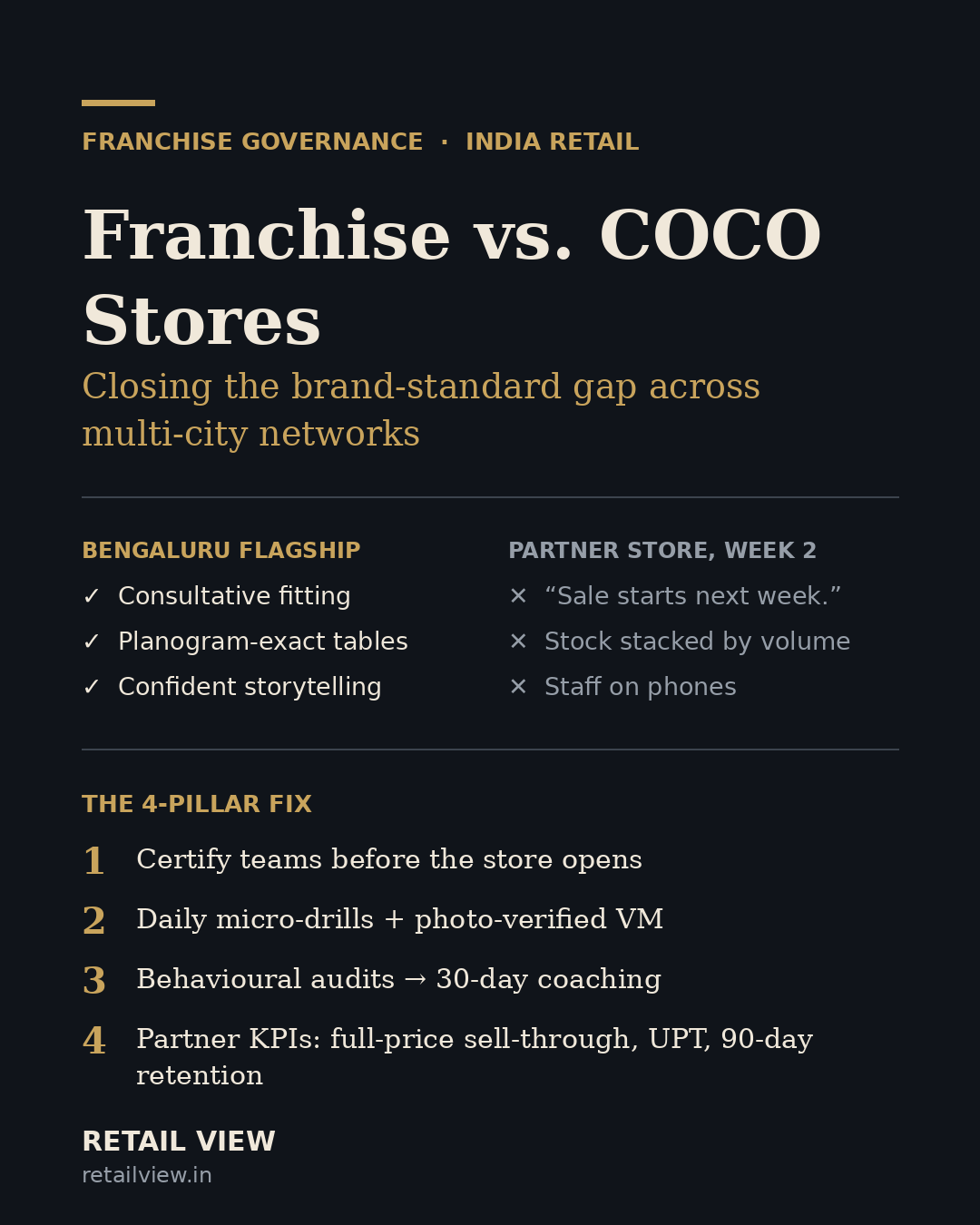
A shopper walks into a global sneaker-and-apparel brand’s flagship in Bengaluru’s Indiranagar on a Saturday. Within a minute, an associate asks what she runs on, checks her gait, brings out two cushioning options and explains the difference in midsole foam. The focal table matches the global campaign. She leaves with shoes, socks and a training tee at full price.
Two weeks later she visits the same brand’s franchise store in a Pune mall. The focal table is stacked three deep with mixed sizes. Two associates are on their phones. When she asks about the same shoe, the first answer is, “Sale starts next week, ma’am—wait for 30% off.”
Same logo, same product and same price tag, but a very different brand. This is no longer an edge case, because partner-run doors are now the main way global brands scale in India.
The network math has shifted. Bata India’s FY2025-26 annual report describes a network of close to 2,000 stores, including 1,100+ company-owned and 700+ franchise stores, and says expansion in Tier 3–5 towns is happening “majorly through Franchise route.” Arvind Fashions’ leadership told investors that its own COCO share was “less than 20%,” and its FY25 results presentation reported 120 new stores opened “largely through FOFO route.” For Aditya Birla Lifestyle Brands, HDFC Securities’ September 2025 initiating-coverage report says about 70% of stores for the core brands (Louis Philippe, Van Heusen, Allen Solly, Peter England) run on a franchisee model, while The Ken puts the share at three in four.
Global brands use the full range of entry structures. Zara operates through Inditex Trent Retail India, a 51:49 joint venture with Tata’s Trent. Reliance Brands operates long-term franchise and master-franchise partnerships, including Gap and Max Mara’s MAX&Co. Metro Brands holds exclusive rights to own and operate Foot Locker stores in India and Crocs “full price” stores across western and southern states. Skechers, which crossed 500 Indian stores in 2026, runs a mix of company-owned and franchise doors.
Tier-2 is where the gap widens. Knight Frank’s Bharat Internationalised 2026 study finds that American brands account for 46% of international stores in Tier-2 India, and that Tier-2 cities have added 5.9 million sq ft of Grade A retail space since 2020, more than three times the Tier-1 addition. No reliable public figure gives the franchise share of Tier-2 openings across the industry. The operating pattern is consistent, though: the further a door sits from the regional office, the more likely it is partner-run.
The Root Causes: Why Franchise Stores Drift from Brand DNA
Partners do not set out to dilute the brand. They respond rationally to the incentives and information the brand gives them.
1. Margin pressure vs. capability investment. A franchisee’s P&L is dominated by rent, staff and inventory risk. CBRE India’s 2018 analysis put apparel rent-to-revenue at “approximately 15-20%,” which leaves little headroom. In that context, two days of off-floor training for six associates looks like lost Saturday sales, not an investment. Training becomes a non-billable cost, and new hires learn by shadowing whoever happens to be on shift.
2. The “telephone game” of product and VM rollouts. A seasonal brief travels from global HQ to the India brand team, then to a regional franchise manager, then to the store manager, often as a 60-page PDF. Each handoff loses context. The fit story behind a tapered chino, or the reason a handbag sits at eye level beside a matching wallet, gets reduced to “put the new stock in front.”
3. The discount reflex over consultative authority. Indian shoppers have been trained to wait. Wazir Advisors’ India Apparel Market Review 2020–25 shows Myntra’s listed average discount rising from 28% in 2020 to 43% in 2025, with 50–70% markdowns increasingly common during mega-sale windows. An associate who cannot explain full-grain versus corrected-grain leather, or diagnose a pronation issue, has only one tool left: price.
4. Churn erases capability faster than you can build it. TeamLease Services’ Balasubramanian A has said churn in blue-collar retail roles “typically” ranges between 45% and 75%. Quess Corp’s FY25 Pulse Report notes that 27% of its retail staff exit within three months. Good Business Lab adds a structural point: supervisory roles in retail “are often filled based on operational experience rather than formal training in people management.”
The selling-skill gap is not unique to India. McKinsey’s research on retail selling found that, at one retailer, associates failed to ask to close the sale 86% of the time. The BoF–McKinsey State of Fashion 2025 report names upskilling store associates as executives’ top in-store priority.
The 4-Pillar Franchise Governance Framework
Pillar 1: Pre-Launch Readiness & Certification Gates
Most brands already refuse to open a store until the civil fit-out, lighting and fixtures are signed off. Apply the same rule to people.
- Make team certification a hard gate. No store opens until at least 80% of the floor team and 100% of shift leads pass three assessments: product mastery (fit, fabric, leather and technology claims), brand hospitality (greeting, needs discovery, fitting-room protocol) and POS and clienteling hygiene (capturing customer data, exchanges and endless-aisle orders).
- Certify at a COCO “academy store.” Run two to three days of supervised floor practice at the nearest flagship, so partner staff see the standard rather than only read about it.
- Write it into the franchise agreement. Link the launch date, opening-stock release and marketing support to certification sign-off, just as they are linked to fit-out handover today.
Pillar 2: Rhythm of Execution (Micro-Drills & VM Telemetry)
Replace thick seasonal PDFs with a daily operating cadence.
- 15-minute morning huddle. A fixed agenda: yesterday’s UPT and ATV, today’s hero product, one 3-minute role-play (for example, handling “Will this go on sale?”), and the day’s VM checklist.
- 4-minute mobile refreshers. Push one short video or quiz per collection drop to associates’ phones, then repeat key points at spaced intervals. Research on spaced repetition, including a 2025 Academic Medicine study that randomised 26,258 family physicians and residents, shows that distributed practice improves long-term retention compared with a single session.
- Timestamped photo verification. Windows, focal tables and the wall bays need geo-tagged, timestamped photos submitted within 24 hours of a floor-set, and reviewed against the planogram by a central VM team within 48 hours. A non-compliant table should trigger a fix-by deadline, not just a red cell in a spreadsheet.
Pillar 3: Unified Mystery Audit & Diagnostic Coaching
Many audit programmes measure the wrong things and then punish the wrong people.
- Score behaviours, not impressions. Blessing and Natter’s 2019 Journal of Retailing study of three service retail chains found that mystery shoppers’ overall satisfaction with a salesperson “has, by itself, no significant effect on sales performance.” Audit rubrics should therefore score observable steps: greeting within 60 seconds, at least two needs-discovery questions, a fit or try-on offer, cross-category attachment (belt with trousers, care kit with suede) and a closing ask.
- Calibrate the auditors. Use the same rubric in COCO and franchise stores, and double-score 10% of visits to keep evaluators consistent.
- Trigger a 30-day coaching sprint. Any store below threshold gets a named coach, two in-store observation sessions, a weekly scorecard review and a re-audit on day 30. McKinsey’s “Unlocking the potential of frontline managers” found that at some companies, district managers spent just 4 to 10 percent of their time, as little as 10 minutes a day, coaching teams. This pillar deliberately shifts that balance.
Pillar 4: Commercial Alignment (Linking Partner Economics to Brand KPIs)
What a brand reviews in the monthly partner meeting shapes how the partner runs the store.
- Move from gross sales to health metrics: full-price sell-through, UPT, ATV, NPS and 90-day staff retention.
- Tie incentives to the scorecard. Link a share of partner margin, consignment terms or marketing co-investment to scorecard bands. Arvind Fashions has said its shift to a consignment model gave it “full control over our inventory in the franchise stores.” That kind of inventory control makes full-price discipline enforceable.
- Make the people case in rupees. Wharton’s Marshall Fisher, Santiago Gallino and Serguei Netessine reported in Manufacturing & Service Operations Management (2021) that adding sales staff at a large specialty retailer, implemented in 168 stores over six months, produced a 4.5% revenue increase and a nearly US$7.4 million annual profit increase after labour costs. Capability spending pays for itself when it is targeted well.
The Governance Benchmark Table
| Operational Dimension | COCO Flagships | Unmanaged Franchise Stores | Governed Franchise Networks |
|---|---|---|---|
| Hiring & Onboarding | Structured profiles; academy induction before floor | Hired on availability; learn by shadowing | Brand-defined profiles; certification gate before opening |
| Product Storytelling | Fit, fabric and tech claims delivered with confidence | Generic features; price as default pitch | Collection micro-drills; storytelling scored in audits |
| Visual Merchandising Discipline | Planogram-exact; central VM team on call | Tables restocked by volume, not story | Timestamped photo verification within 24–48 hours |
| Discount & Margin Control | Markdowns centrally timed | Early, informal price-offs to close sales | Full-price sell-through on partner scorecard; consignment or markdown governance |
| Store Manager Coaching | Regular line-manager reviews | Ad hoc; focused on sales targets | 30-day coaching sprints triggered by audit scores |
| Audit Cadence | Monthly internal plus mystery audits | Annual or event-driven; punitive | Monthly calibrated behavioural audits, same rubric as COCO |
Executive Diagnostic Checklist
Ask your team these four questions before your next partner review:
- Could any franchise store open today without a single associate passing a product-mastery assessment? If yes, your gating is about civil works, not the brand.
- How many hours after a floor-set do you know whether the Ahmedabad window matches the Bengaluru window? If the answer is “at the next regional visit,” you have no VM telemetry.
- Do your audits generate coaching plans, or only scores? A score with no 30-day follow-up is a compliance cost, not a capability investment.
- Is full-price sell-through on your partner scorecard, and is 90-day staff retention? If the partner review is only about gross sales, the discount reflex is being rewarded.
Closing Perspective
India’s growth runway for global fashion, footwear and accessory brands is real. Tier-2 cities are building better-quality retail space than many metros. But real estate velocity only buys the right to be judged. Every partner-run door is either compounding the brand’s equity or spending it.
The brands that lead in India over the next decade will not be the ones with the most stores. They will be the ones whose Chandigarh store greets, fits, styles and holds price exactly like their Bengaluru flagship, because the operating system makes that the easiest thing for a partner to do.
Data note: network and market figures are drawn from company filings, investor communications and named research reports (Bata India, Arvind Fashions, Knight Frank India, Wazir Advisors, TeamLease, Quess, Good Business Lab, McKinsey, Wharton and the Journal of Retailing). Attrition figures for Indian store staff vary widely by source and method. The opening store scenario is illustrative.
Retail View designs store-floor training and coaching programmes for fashion, footwear and accessory brands and their franchise partners in India. Talk to us about auditing your partner network.